For more than a century, conventional refineries have powered global growth — while locking in massive carbon emissions and environmental cost. Meeting today’s climate and energy security goals requires a new class of industrial infrastructure.
Our e-Refinery is designed to become that backbone. The platform enables the production of multiple e-fuels, including clean hydrogen and green ammonia, with future pathways to e-SAF, e-methanol, and e-DME — supporting decarbonization across power, transportation, and industrial sectors.
What differentiates our e-Refinery is its ability to operate in carbon-free and carbon-negative configurations, using renewable inputs such as air, steam, biomass, and waste materials, including waste tires. The system avoids the extreme pressures and thermal loads typical of conventional processes, improving safety, reducing complexity, and enabling modular scalability.
By converting abundant renewable and waste resources into high-value fuels, Our e-Refinery delivers both global climate impact and local economic benefits through cleaner industries, circular resource utilization, and resilient energy infrastructure.
Electrodeless-Driven Plasma Conversion
At the core of the e-Refinery is electrodeless based microwave-driven plasma technology, capable of generating the extreme temperatures required for chemical reforming with high controllability and rapid response. Unlike conventional thermal systems, electromagnetic energy allows direct coupling to the reaction zone, improving efficiency, process control, and feedstock flexibility.
Proven at Industrial Scale
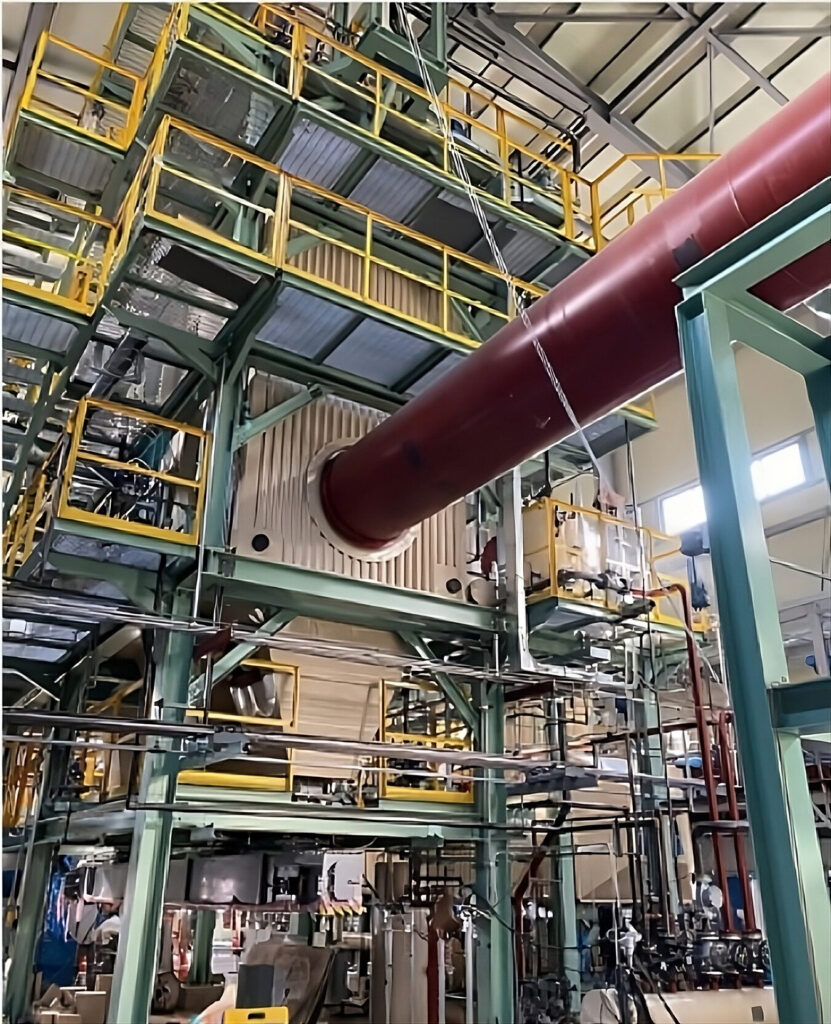
Microwave-plasma conversion is not a laboratory concept. Similar systems have been engineered and deployed at commercial scale, including the world’s first industrial microwave-plasma gasification facility commissioned in South Korea. This project demonstrated that microwave-driven plasma systems can be built and operated continuously at industrial scale, validating the underlying physics and engineering.
While prior deployments faced commercial and operational challenges, they confirmed the technical feasibility and scalability of microwave-based plasma conversion — significantly reducing technology risk for next-generation platforms.
The FlexiH Advantage
FlexiH builds on this validated foundation with a commercially optimized system architecture, designed specifically to overcome historical barriers to scale. Key advantages include:
Modular and scalable reactor design
Improved system integration and energy efficiency
Flexible feedstock compatibility
Deployment models aligned with real-world industrial economics
By combining proven electromagnetic conversion principles with proprietary design and commercial focus, FlexiH transforms validated technology into a financeable, repeatable clean fuel platform.
Revolutionizing ammonia for a sustainable world. Using clean hydrogen and breakthrough processes, we produce low-impact ammonia that fuels greener agriculture, energy storage, and industrial innovation without compromising performance or the planet.
Power the future with zero-emission hydrogen. Our cutting-edge, eco-friendly technology transforms renewable resources into clean hydrogen delivering a sustainable, scalable energy solution for industries ready to lead the green transition.
Our proprietary solution applies an electrodeless plasma approach that operates without catalysts, offering an alternative pathway for clean energy production. Compared with conventional processes such as steam methane reforming (SMR), electrolysis, and plasma arc systems, this technology is designed to improve operational efficiency while reducing system complexity and operating costs. By avoiding the use of catalysts and high-pressure configurations, it aims to support more scalable and economically practical deployment, contributing to the broader transition toward lower-carbon industrial energy systems.